Card sets to make sentences
The words of a theme become sets of cards to cut out, with their determiners and their verbs, so that the child builds sentences of their own.
“The sentence factory” now sorts the words of the resource into sets of cards to cut out. In “Create a resource”, the resource is at two steps: “Use the words again” on the speaking path, “Write sentences” on the writing path. The child picks from the sets to build a sentence, says it, then reads it. You no longer write the sentences in advance.
What each set holds
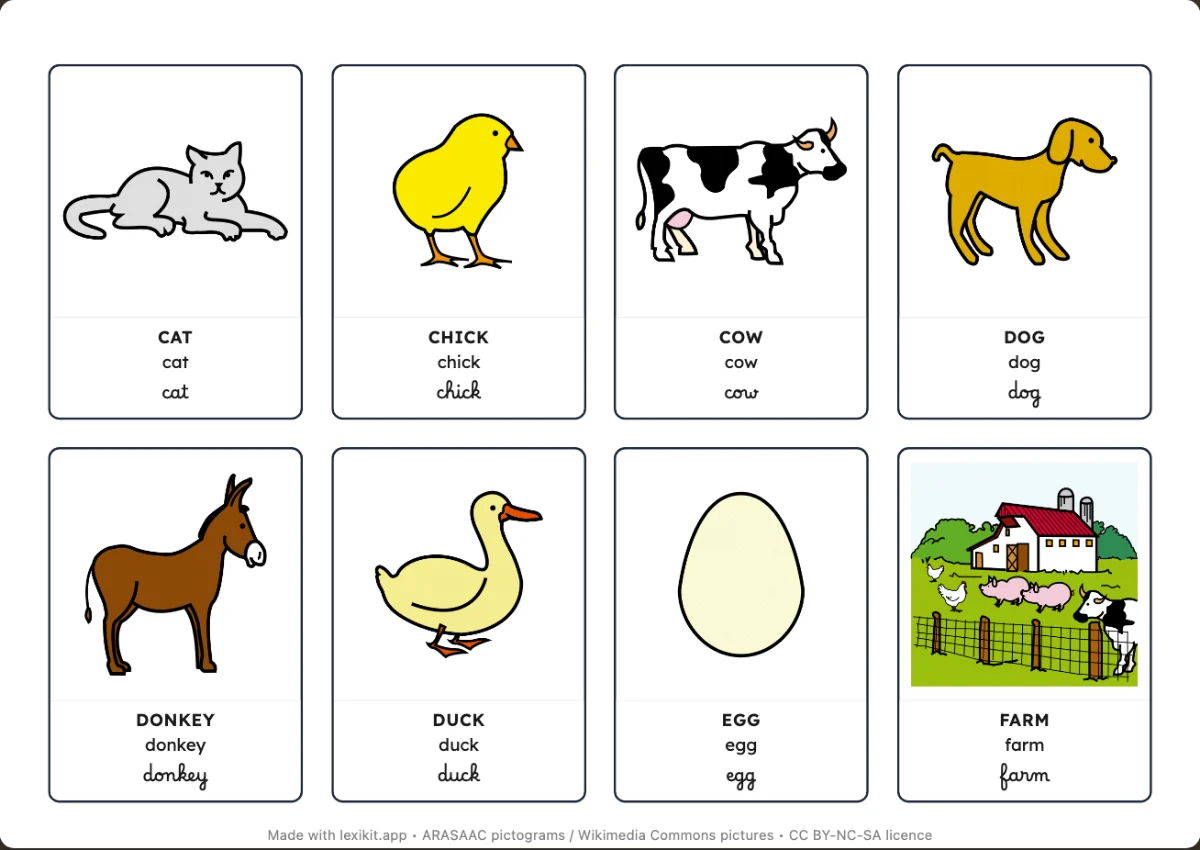
The set “Words of the resource” has the nouns, the adjectives and the other words, with their picture. The set “Determiners” has the ones these nouns take, from the gender of each noun in the lexicon in French and Spanish. The boxes of “Determiners” choose “the”, “a, an”, “my” or “this”.
“Verb form” ticks the present, the past or the going to future, one form or several. The verb has a card in each form ticked: “eats”, “ate”, “is going to eat”. The French nursery school programme expects, before age 4, “a system of three tenses: present, passé composé, present with a near future value (aller)”. The set “Time words” follows the forms ticked: “now” with the present, “yesterday” with the past, “tomorrow” with the going to future.
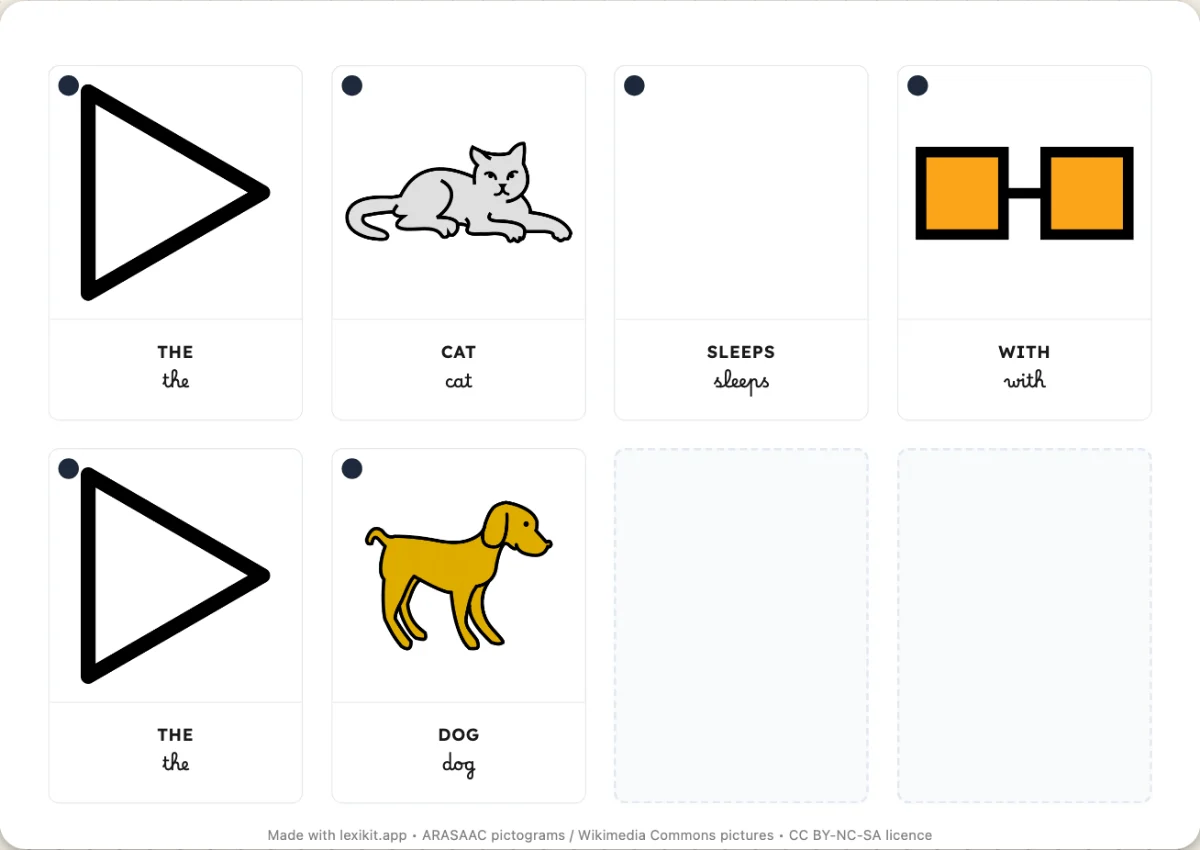
Three sets can be added in Format › “Card sets”: pronouns (“he”, “she”, “it”), “To be and to have” (“is” and “has”, in the chosen form) and little words (“and”, “in”, “on”, “under”, “with”, “of”, “to”, “at”). The set “Capital and full stop”, ticked by default, gives “The” and “A” to start a sentence, “He”, “She”, “It” with the pronouns, and three full stops to end it. In capitals alone, “THE” serves for both cards: the set then keeps the full stops. A word without a picture, like a determiner, is written alone, large, on the colour of its part of speech. Under the sets, the preview gives the number of cards and pages.
The verb in the third person
A card carries one form of the verb. I chose the third person singular, the one that goes with “he”, “she”, “it” and with a noun: “the cat eats”, “Lea eats”. The child puts the subject before the verb, and Lexikit never takes it from a picture. The “Verbs” option of the cards, which took the pronoun from the picture, is withdrawn the same day (From word to sentence). “I”, “we” and the plural would need one more card per verb and per person. They are not in the sets.
Sentences written in advance
The factory is made from the words of the resource alone. A sentence written in advance goes in “Copy the sentence” or in “Sentence models to glue”, at the step “Write sentences”. Added to the file of the factory, these resources start with ready sentences that hold its words, six at most, and these words are highlighted. A sentence you write there gives its nouns, verbs and adjectives to the words of the file, and the factory gets them. I first put the teacher’s sentences in a set of the factory, “My sentences”. The column then mixed words and sentences, with two theme buttons, and I withdrew this set on 21 October 2026.
The word alone or on the back
Since 21 October 2026, “Picture: No”, in Format › Content, prints the word alone. The card loses the room of the picture, and a page of normal size holds 24 cards instead of eight. The card keeps the colour of the word’s part of speech.
“On the back” adds a back page after every page, as on the word cards. With the pictures, “The word” leaves the picture alone on the front and writes the word behind it. Without pictures, “The picture” puts the picture behind the word. The child reads the card, turns it over and checks. The dot of the marker, chosen by default, is always on the side of the word. Print double sided, flipped on the long edge.
Building on screen
“Launch” opens “Build a sentence”. The sets are on the table, sorted by kind of word. A touch puts a card at the end of the sentence, another takes it back, and “Read” has the voice say the sentence. Lexikit does not check the sentence, the class says whether it works.
Lexikit prints one card of each determiner. For two groups to build at the same time, print the page of the determiners twice. The pronouns, the time words and the little words exist in French, English and Spanish.