From word to sentence, in two paths
“Create a resource” sorts the resources in two paths, speaking and writing, which both end on sentences made with the words of the resource.
In “Create a resource”, the resources are now sorted in two paths, “Vocabulary out loud” and “Vocabulary in writing”. Two tabs, “Speaking” and “Writing”, show their steps one under the other. Both paths end on sentences made with the words of the resource. “The sentence factory” is at the last step of each.
The four steps of speaking
The French programme support booklet “From age 5” (Eduscol, 2025) sets a goal for vocabulary. The pupil should move “from language in context to language that evokes, through the discovery of new words, the structuring of the lexicon, the memorisation and the autonomous reuse of this lexicon” (page 3).
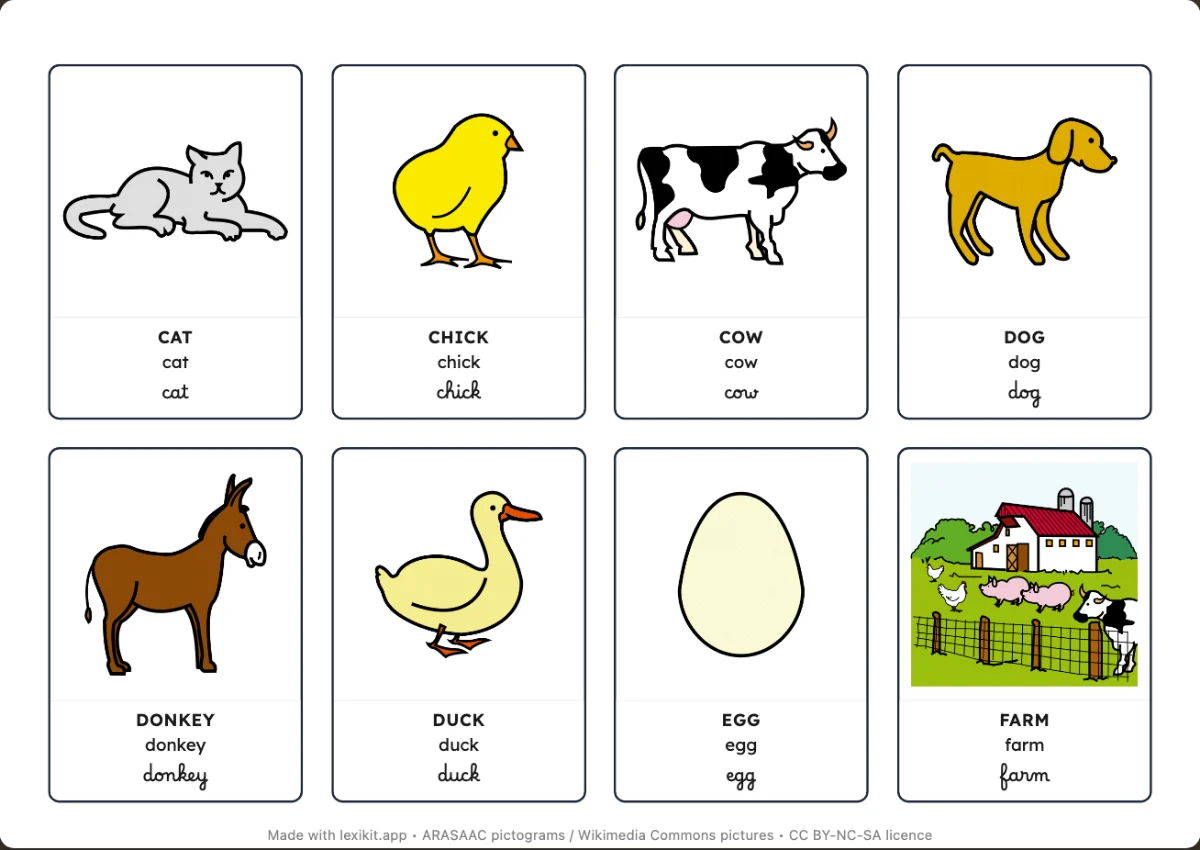
These four steps are those of the French nursery school programme of 2024: “bring new words”, “structure the lexicon”, “have them memorised”, “reuse the vocabulary learnt” (page 2). The first path follows them. The words first come in class, with the story, the outing or the objects. “Discover the words” has the cards, a picture dictionary to show and put up. “Organise the words” sorts them into categories, with the sorting boxes, the odd one out and Happy Families. The programme also speaks of the “semantic and morphological links” between words, and word families have no resource in this step yet.
“Remember the words” has the child say them again, with the games, the hidden picture, the picture wheel and the puzzles. The booklet asks to “use the words and expressions in sentences during short, structured, planned and ritual sessions” (page 35). The games have a line “Said while playing” in the Format panel. In the bingo, the child answers “Who has the leaf?” with “I have the leaf.”. The rule card prints this sentence, and the bingo on screen writes it under the picture drawn. In Dobble and Lynx, which are played fast, the child says the word alone.
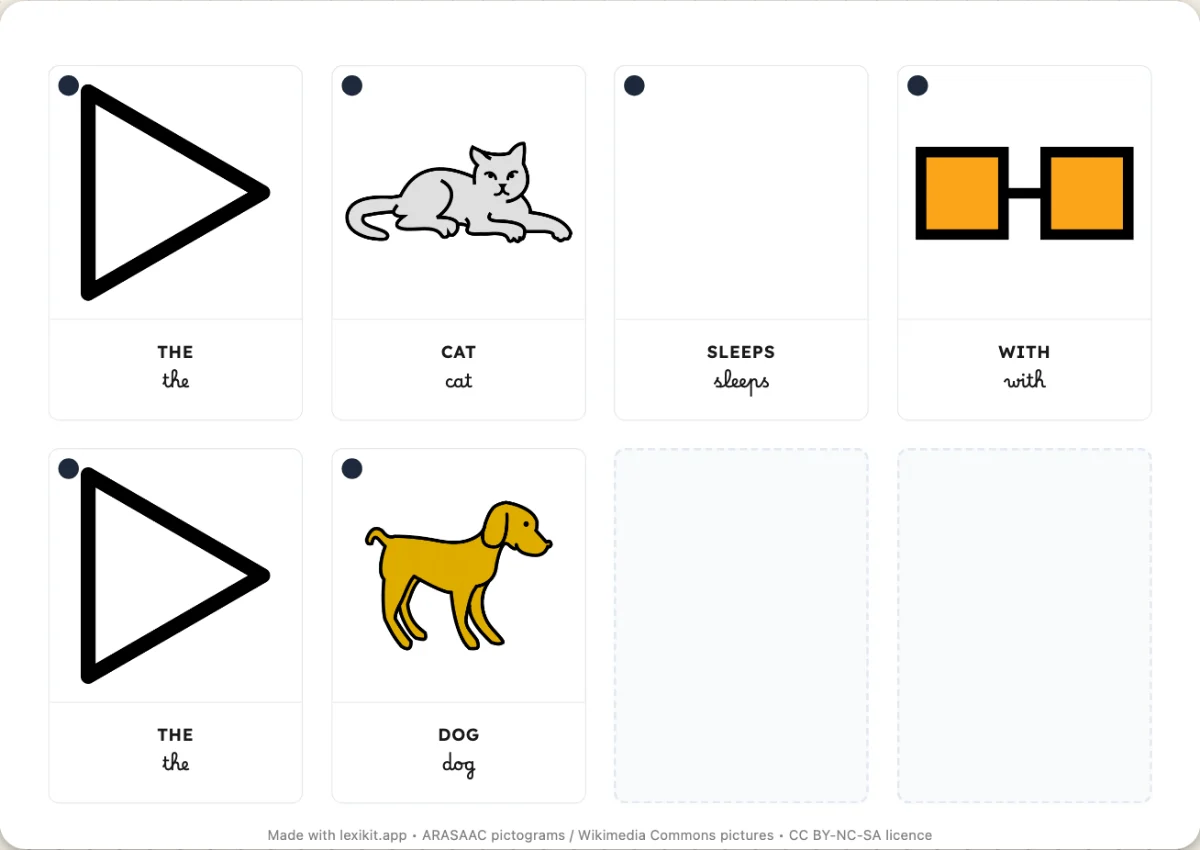
“Use the words again” has “The sentence factory”. The child builds a sentence with the cards, then says it. For this step, the programme also names “social scenarios in the play areas”, “dictation to the adult” and “telling picture books”. These moments are lived in class, and Lexikit has no resource for them.
The verb follows the subject of the sentence
The “Verbs” option of the cards and games is withdrawn, and the resources set to “Conjugated” write the infinitive again. It wrote “he is cutting” under the picture of a boy who cuts. The pronoun came from the picture, so from the person who does the action. The subject of a sentence does not always do the action: in “Leo gets a present”, Leo does nothing.
The French guide “Grammar from first to sixth grade” (Eduscol) approaches the subject through meaning, then through form. It states that “the subject group gives its marks of person and number, even of gender, to the verb” (page 28). In a resource of sentences, the verb takes the person of the written subject: “the cat sleeps”, “the cats sleep”. “Verb form”, in the word window, chooses the tense only. On a game card, a verb stays in the infinitive, as in the lexicon. The cards of “The sentence factory” write it in the third person, without a subject, and the child puts the subject before it.
What moves
The clothespin cards move to “Observe the word”. “Seek and find”, “Shadows”, “Counting” and “Patterns to continue” leave “Create a resource”, because no step of the two paths matches them. A resource already made with one of them still opens. “Word cards to cut out” becomes “The sentence factory”. The menu of a file puts this resource at the step you chose it in, “Use the words again” or “Write sentences”. Its card sets have their own article.
In a file, the left column is the same for every resource: the words, then the sentences in a resource of sentences. The menu of the file shows the steps of the path, and an empty step has its “Add a resource”. The writing path has four steps too, described in a separate article. A French sentence typed in the near future, like “Il va pleuvoir”, keeps two cards, “va” and “pleuvoir”.
The resources that apply it