The four steps of writing
The writing path sorts the resources in four steps, from the word read to the word written in a sentence, after an Eduscol guide for CP.
In “Create a resource”, the tab “Writing” now has four steps: “Read the word”, “Observe the word”, “Write the word” and “Write sentences”. They sort the worksheets where the child reads the word, takes it apart into sounds and letters, then writes it.
A word observed, hidden, then written
No official text sets steps for the written word. I followed the French guide “Pour enseigner la lecture et l'écriture au CP” (Eduscol, 2019), on teaching reading and writing in the first year of primary school. It has the class observe a word found in a text: “the pronunciation of the word, its spelling aloud, its division into syllables, its division into phonemes” (page 96). The teacher then hides the word, and the pupils write it “without the model” or “from dictation”.
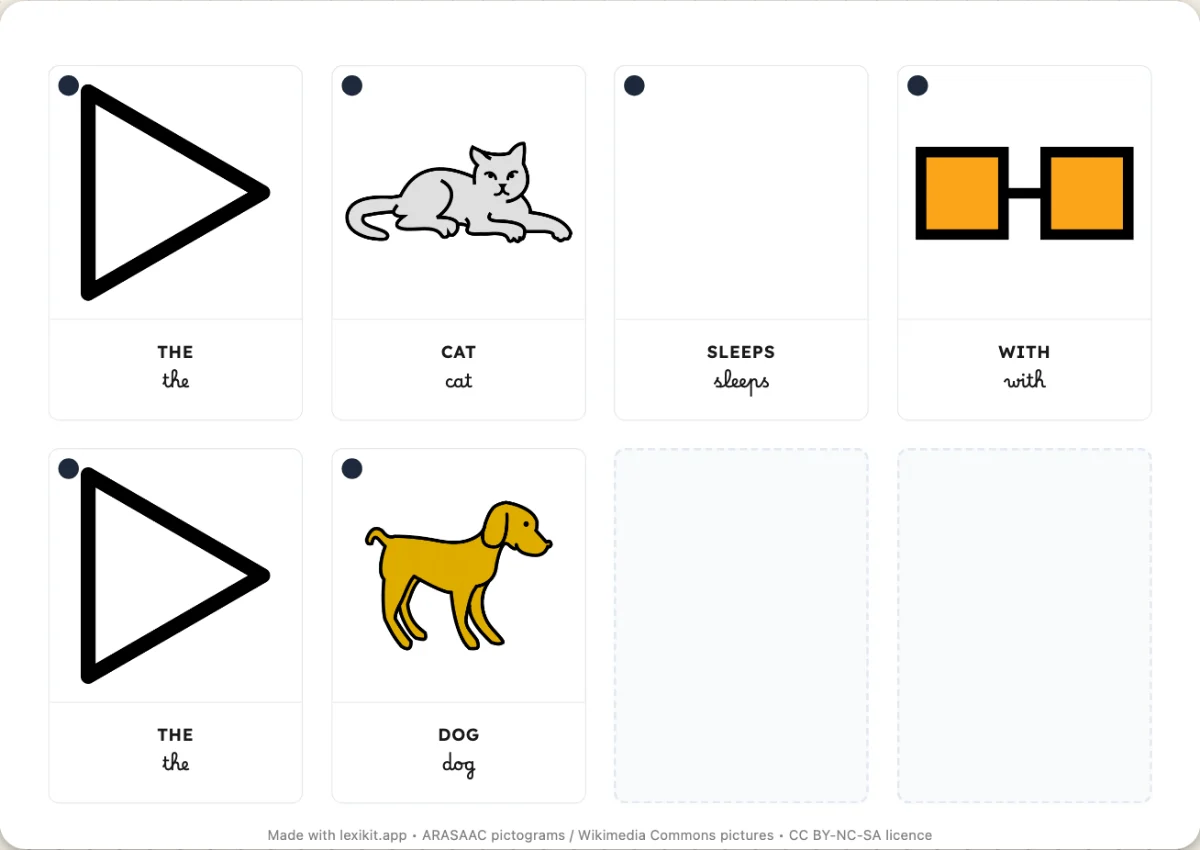
The four steps follow this order. “Read the word” has the worksheets where the child recognises the written word. “Observe the word” has the worksheets on syllables, sounds and letters, with the clothespin cards. “Write the word” has the resources where the child writes the word, from the model to memory. “Write sentences” has the cards to make sentences, which are also in “Use the words again” on the speaking path, and the sentences to copy. Since 21 October 2026, the order is “Observe the word”, “Write the word”, “Read the word”, then “Write sentences”: the child reads the word after observing and writing it.
From nursery school to the end of CP
In each step, the most used resources come first. The progression of the programme, from the first year of nursery school to the end of CP, the first year of primary school, comes from the settings and the words chosen. Before age 4, the child finds “the label of their first name” among others (programme, page 7). In CP, the child copies “a text placed at a distance (or on the back of the sheet)” (CP programme, page 10), then writes from dictation.
The line “Model word” has the same choices in every resource of the step “Write the word”: “To copy”, “On the back”, “Seen then hidden”, “Dictation” and “Picture only”. Each resource keeps those it can do.
The words chosen do the rest. In nursery school, the French programme has the children write words “without double consonants or silent letters” (page 11). In CP, it gives only words the child can decode. “Transparent words” and “Choose my graphemes”, in “Full lexicon”, keep these words.
Syllables and letters on the writing path
Phonology belongs on this path: the French nursery school programme places it under the heading “Passer de l'oral à l'écrit : se préparer à apprendre à lire”, from speaking to writing, getting ready to read (page 7). Picture puzzles move to “Vocabulary out loud”, where the child puts the picture back together, then names it. “Write the word” now has “Syllable puzzles”: a small square of 7 cm for each word, its picture cut into one strip per syllable, the syllable written at the foot of its strip. The child puts the syllables back in order, then reads the word. The worksheet “Write the word” takes the name “Write the word on the lines”, as “Write the word” has become the name of the step.
The order of the steps is a choice of Lexikit, drawn from a guide that describes an approach without cutting it into steps. Dictating to the adult, which the French programme practises from the first year of nursery school, has no resource yet.