The plural of nouns and the feminine of adjectives
A noun now has its plural, and an adjective its feminine. In a sentence, “apples” finds the card of “apple” and its picture.
Until now, Lexikit knew “apple” but not “apples”. In the sentence “I eat apples”, the last word had no picture.
One word, several forms
The plural is now a form of the word, like the conjugated forms of a verb. It appears in the word window, in the “Grammar” part: “horses”, “boxes”, “potatoes”. Lexikit writes it for you, and you can correct it. The “Plural” button makes a picture of the word the picture of the plural. “A friend” then shows one person, and “friends” a group.
In French and Spanish, adjectives also have their feminine: “verte” and “vertes”, “roja” and “rojas”. The feminine of a noun, such as “boulangère”, stays a separate word.
French irregular plurals come from Lexique 3.83, a database of French built by the researchers Boris New and Christophe Pallier. English and Spanish follow their own rules.
In sentences and resources
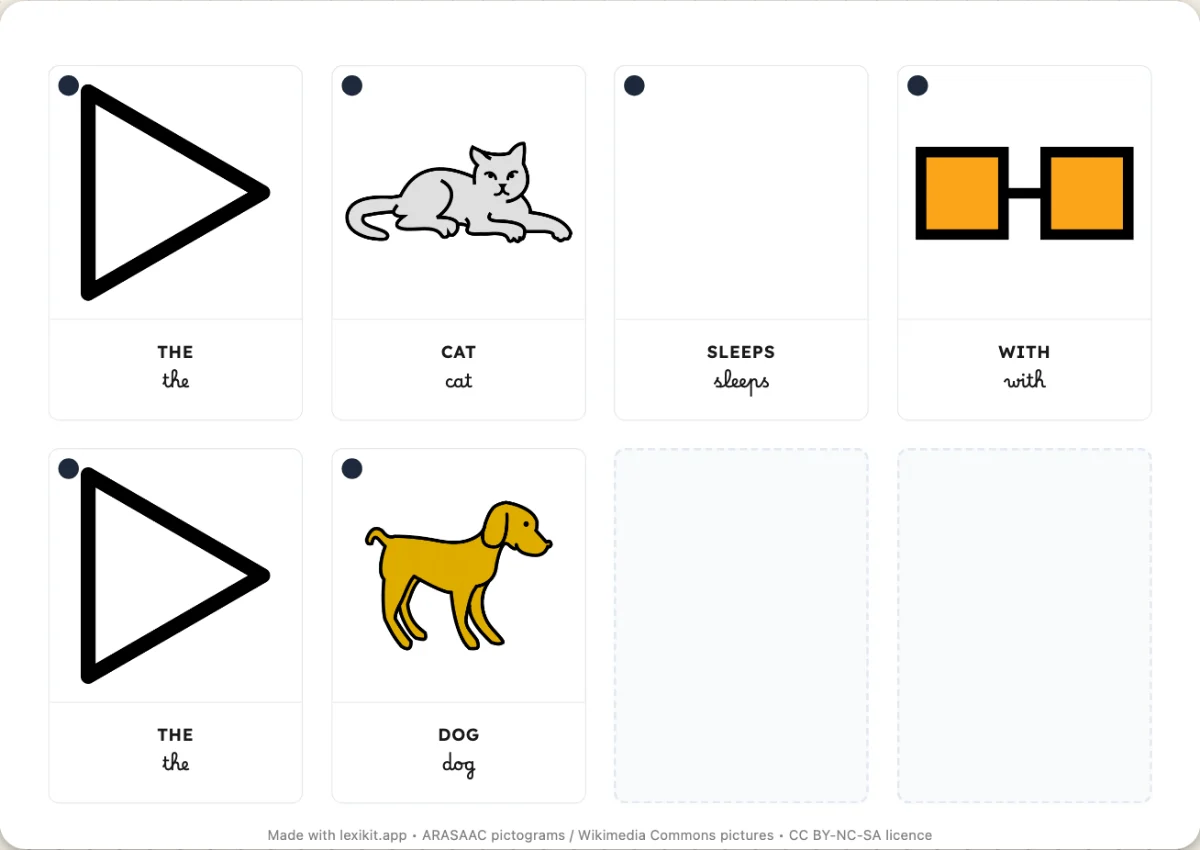
In a sentence, “apples” takes the card of “apple”, and the French “une robe verte” (a green dress) that of “vert”. To choose, Lexikit looks at the small word before it: “the walks” is a noun, “she walks” a verb. The sentence keeps what you wrote.
In a lotto, a memory game or a worksheet, the “Word form” option writes the word in the singular or the plural, for that resource only. If you type “apples” in the search, Lexikit adds “apple” in the plural, without creating a new word.
A lexicon without duplicates
The lexicon held hundreds of pairs such as “friend” and “friends”. When the plural only means “more than one”, the two cards become one. When it has another meaning, it stays a separate word: “glasses”, “clothes”. Your resources look the same as before.