The passé composé and the choice of pronoun
French verbs now conjugate in the passé composé, with the right auxiliary and participle agreement. The pronoun il, elle or on is chosen per card.
Long before they read, children tell what they have done: “Hier, je suis allé au parc.” The French nursery school programme names the passé composé among the first tenses the child uses when speaking. Lexikit now conjugates it, to write the sentences the class tells.
The right auxiliary, the right agreement
Lexikit chooses the auxiliary following the rule taught at school. “Être” is used for verbs of movement, verbs of change of state and reflexive verbs, “avoir” for the others. You write “il est monté”, but “il a monté les escaliers”.
After “être”, the participle agrees with the subject. The “Verb form” option therefore lists each pronoun: “elle est allée”, “elles sont parties”. Exceptions are taken into account, such as “elle s'est lavé les mains”. A form that does not suit you is corrected in the verb's table. Since 20 October 2026, the pronoun follows the subject of the sentence, and “Verb form” chooses the tense only.
In sentences
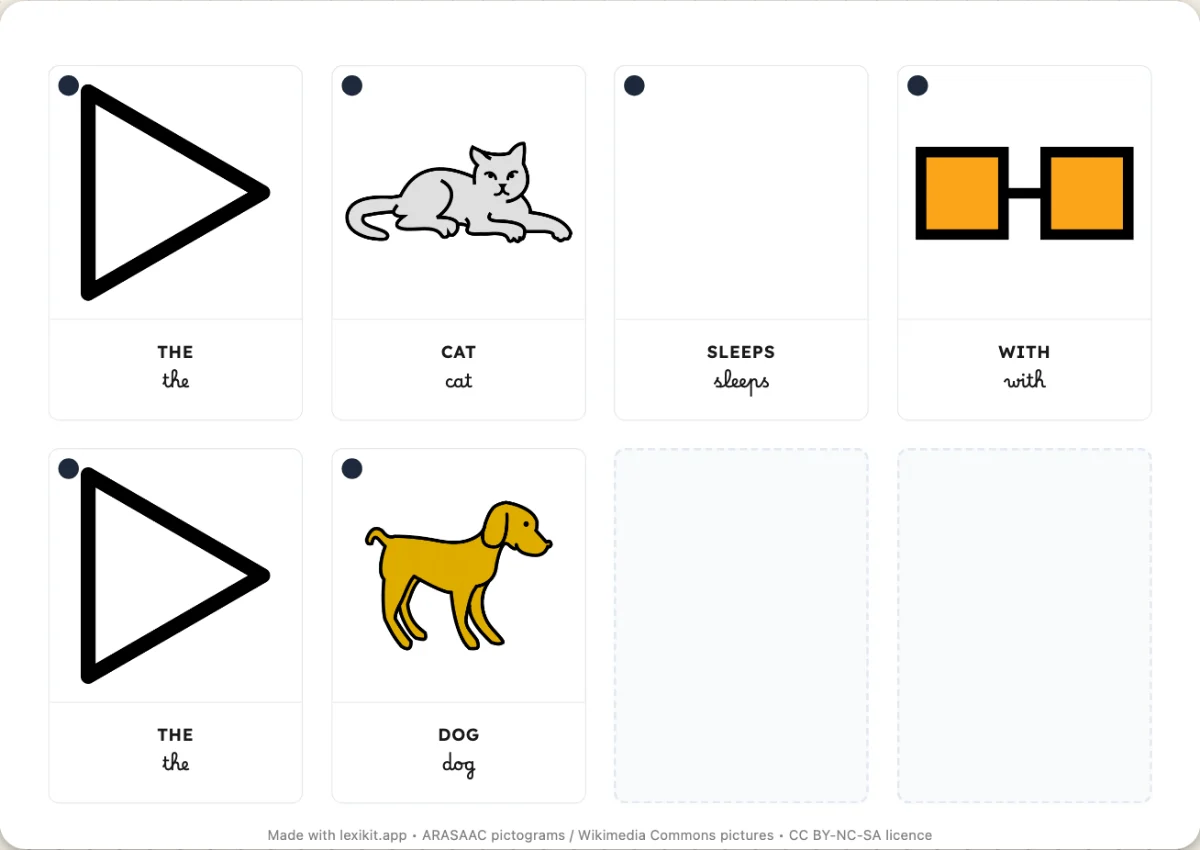
“Il a mangé” makes a single card, with the picture of “manger”. “Je ne touche pas” (I do not touch) and “il y avait” (there was) also find their verb.
Checked forms
French forms come from the Lefff, a lexicon of French word forms. I compared its 7,800 verbs with a second conjugator, then checked the differences in the Bescherelle. Of these verbs, 17 had wrong forms, such as “il se taît” instead of “il se tait”. They are corrected.
In English, the present continuous joins the other tenses: “I am eating”. In Spanish, it is the pretérito perfecto: “he comido”.