Verbs conjugate in your sentences
A verb keeps a single card in the lexicon. In a sentence, it takes the form you write, with its picture, in French, English and Spanish.
In class, a verb is used in a sentence. “Yesterday we went to the farm.” “Tomorrow we will go to the swimming pool.” The French nursery school programme asks children to use tenses to place a moment in the day, the week or the year. Lexikit now conjugates its verbs. In a resource, each verb of these sentences finds its card and its picture.
One card, all its forms
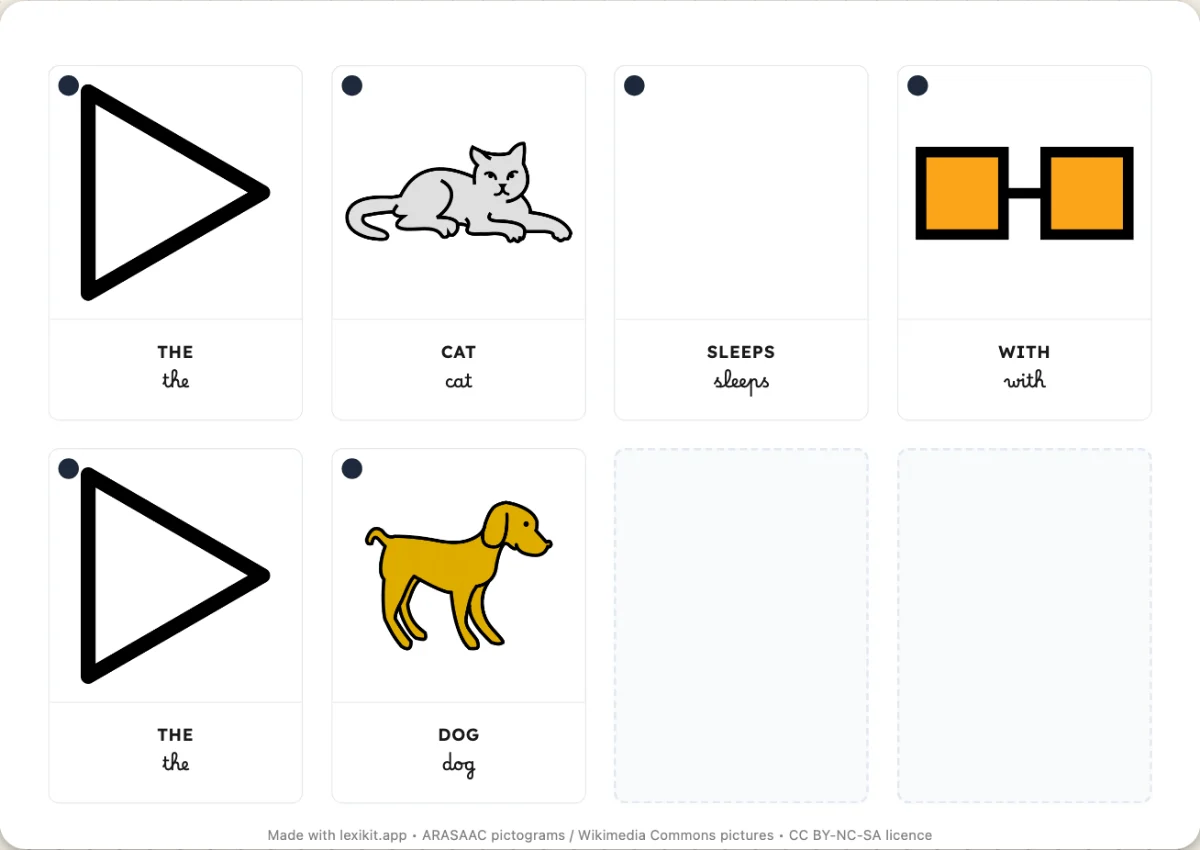
Before, each form of a verb was a separate word. You had to create “eat”, “eats” and “ate”, and choose the same picture three times. With conjugation, “The cat eats a fish” finds the verb “eat” and its picture. The sentence keeps exactly what you wrote. The card brings the picture and the part of speech of the verb, for the colour code of the parts of speech.
When a form can come from two verbs, such as French “suis” for “être” and “suivre”, Lexikit does not choose for you. The word window has a “Link to a verb” button.
A table to check
The word window shows the verb's conjugation, folded under “Show the table”. The present, the past and the future are read there on three lines, the singular next to the plural. A form that does not suit you is corrected in the table, and goes back to the suggested form in one click. This table is for checking the forms. The child meets conjugation in sentences that make sense.
Where the forms come from
French forms come from the Lefff, a lexicon of French word forms built by researchers in natural language processing. Spanish forms come from the open conjugate-esp engine, English forms from an open dictionary of irregular verbs. This data is heavy. It loads only for the language of the resource's words, after the app has opened, so as not to slow it down.
A French verb written in the 1990 spelling, such as “apparaitre”, finds its conjugation and keeps its spelling. A verb missing from these sources is completed by hand.