Categorising to remember better
Sorting words by category makes them easier to understand and remember. What research says, what the curriculum asks for, and what Lexikit does with it.
The words of Lexikit are now sorted into categories. This feature rests on an idea: a word is remembered with the words around it.
A network of words
Vocabulary works like a network. “Apple” is linked to “fruit”, to “pear”, to “crunch”, to “red”. The more links a word has, the easier it is to retrieve, and sorting words creates these links. The Eduscol guide on teaching vocabulary in preschool (2020) writes that memory stores words “as a network or a web” (page 29) and that “the richer a pupil's conceptual system, in its content as in its organisation, the easier it is to activate objects in memory” (page 42, translated from French). The 2024 curriculum asks children to “organise words into categories and networks”.
From the everyday word to the general one
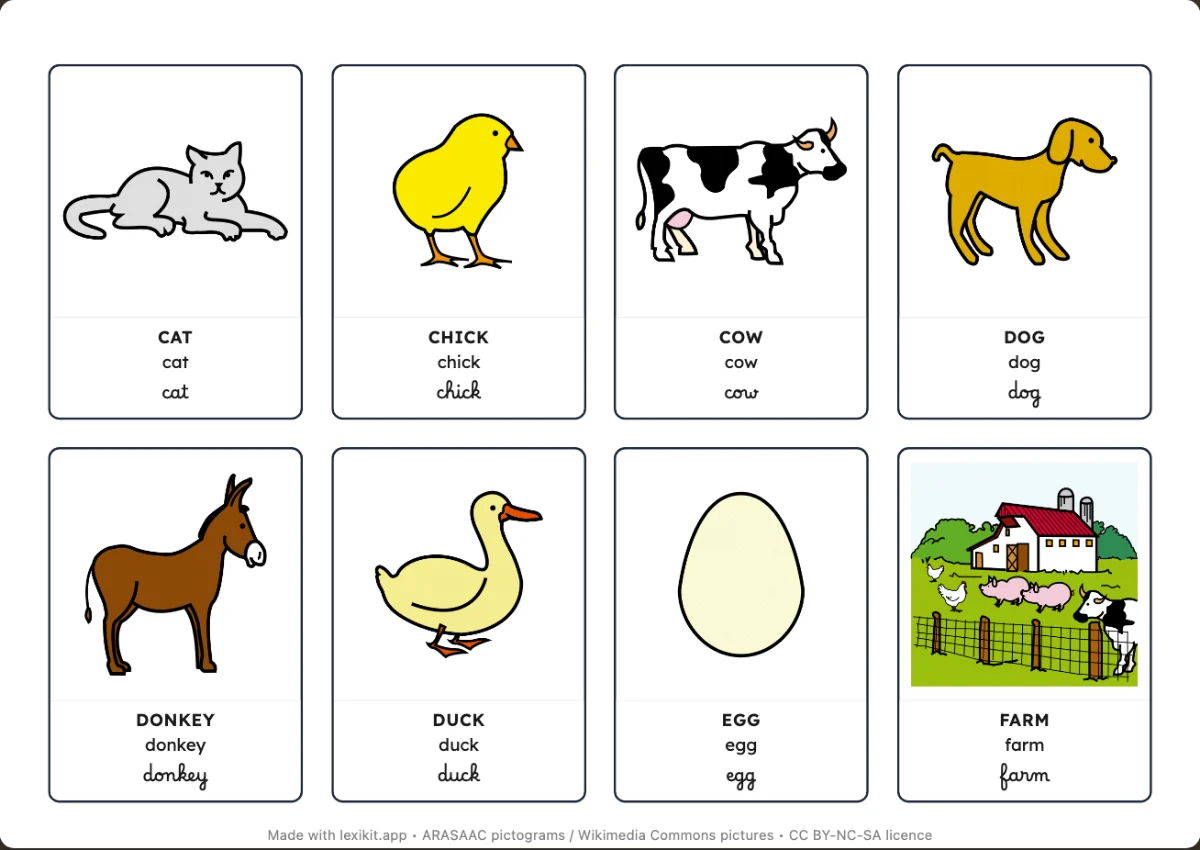
Children first learn everyday words, “dog” or “chair”, before more general words such as “animal” or “furniture”, and before more precise ones such as “poodle”. General categories, such as “animal”, “fruit” or “clothes”, need explicit work. The curriculum follows this progression: sorting, finding the odd one out and putting an object in a category before age 4, then looking for more general words, such as “vehicle” or “animal”, from age 5. Sorting and the odd one out in Lexikit serve this work.
Sorting to understand
When a child hesitates between putting the tomato with the fruit or with the vegetables, the child is thinking about the meaning of the word. A sorting mistake is an occasion to talk about it. That is why Lexikit lets a word belong to several categories.