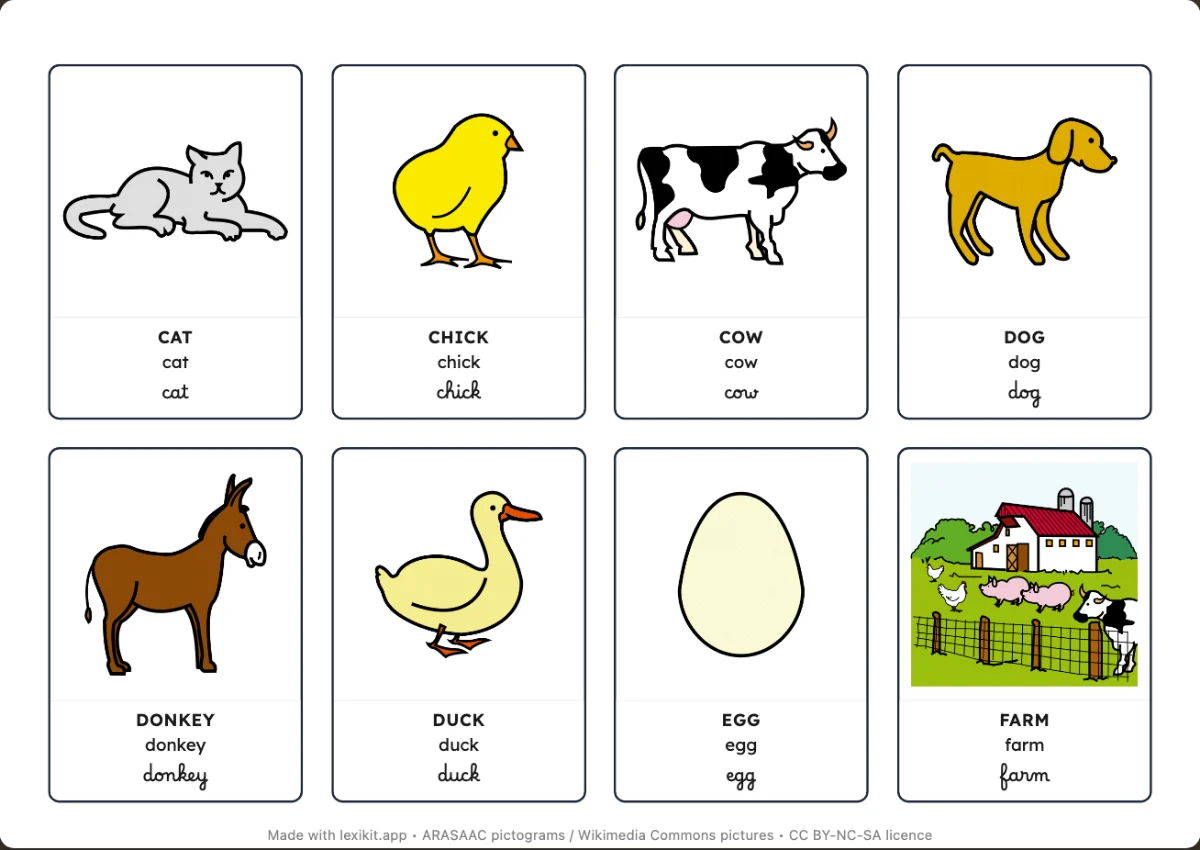
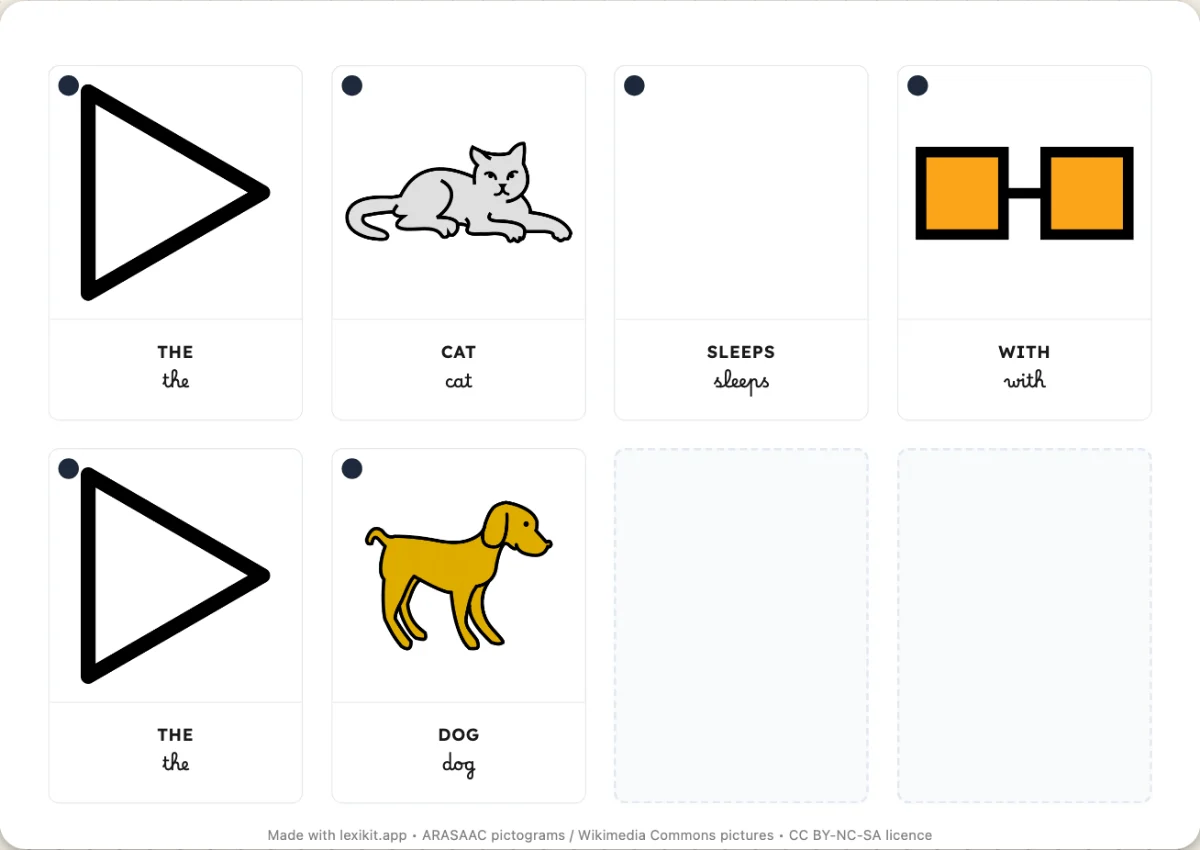
Words to read with the graphemes studied
“Choose my graphemes” finds the illustrated words that can be read with the graphemes taught in class. “Transparent words” leaves out silent letters.
In the first year of primary school, children read and copy words made of graphemes they have already studied. In “Start from criteria…” › “Full lexicon”, the “Choose my graphemes” entry now does this. You tick the graphemes taught in class, and Lexikit finds the illustrated words that can be read with them only. A “Spelling” menu also keeps transparent words, in every list.
Ticking the graphemes taught
The graphemes appear in the order of the ready selections of “Start from criteria…”, in French from “a”, “i”, “l” and “ch” to “ill” and “œ”. This order is a choice made by Lexikit. Each grapheme is ticked on its own, to follow the progression of your reading scheme. “Untick all” starts again from scratch. Lexikit remembers your graphemes on this device for next time.
How Lexikit reads a word
Lexikit compares the spelling of each word with its pronunciation, taken from Wiktionary, the free online dictionary. It tries to split the word into ticked graphemes, each with one sound of the word, in order. In French, “chat” splits into “ch” and “a”, and its t is silent. “loup” needs “ou” and cannot be read with “o” and “u” ticked.
Some letters change their sound depending on the next letter. In French, the c of “ici” is read once “ce” is ticked, the g of “gel” with “ge”, the e of “mer” with “è”. I first kept the rules of the grapheme search. They refused “pomme”, because there an o followed by an m signals the sound “on”. The pronunciation decides better. Only the rules tied to the start or the end of the word remain, such as “er” at the end of “rocher”.
Transparent words
The “Spelling” menu has two choices, “All words” or “Transparent words”. The French preschool curriculum asks teachers to « faire écrire des syllabes, le prénom et/ou des mots orthographiquement transparents (sans double consonne ni lettres muettes) », that is, to have children write syllables, their first name or orthographically transparent words, with no double consonant and no silent letter (BO no. 41, 31 October 2024). With “Transparent words”, “moto” and “vélo” stay, while “chat”, “lune” and “ballon” go. The filter applies to every list, ready or not, and works together with the ticked graphemes.
The words Lexikit does not find
A word whose pronunciation Lexikit does not know never appears. Words borrowed from English, such as “foot” or “steak”, and rare readings, such as “femme” or “sept”, do not appear either, even with every grapheme ticked. In the French lexicon, this concerns 419 illustrated words out of the 6,432 whose pronunciation is known. English and Spanish follow the same method with their own graphemes. A word that appears by mistake, or a word that is missing, can be reported in “Your feedback”.